
Oct 24, 2026
Is Non-Alcoholic Beer OK When You're Quitting Drinking?
Short answer: usually yes, with one big exception. Here's how to tell if non-alcoholic beer helps your quit or quietly works against it.
6 min read · Quitwon
Short answer: for most people quitting, yes. Non-alcoholic beer contains no meaningful amount of alcohol, and holding a cold bottle that tastes like beer solves a real problem, because a lot of quitting is about the missing ritual, not the missing ethanol.
There's one exception, and it matters. For a minority of quitters, the taste and smell of beer are learned triggers, and an alcohol-free beer can switch the whole craving machinery back on within minutes. The drink itself is harmless. What it wakes up might not be.
So the honest answer is "it depends on you," and the rest of this article is how you find out which side you're on before you bet a good stretch of sobriety on it. (If you're still deciding whether to quit at all, the quit alcohol guide starts one step earlier.)
What non-alcoholic beer actually is
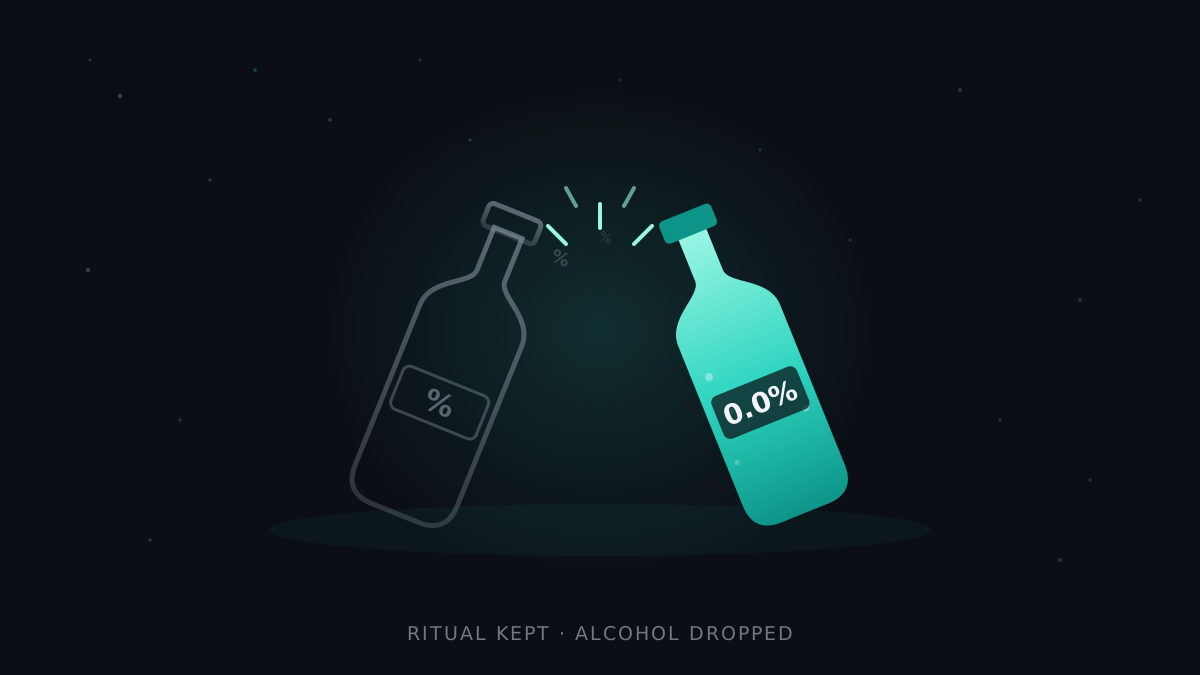
"Non-alcoholic" doesn't mean zero by definition. In the US and most of Europe the label means under 0.5% ABV, and a lot of popular brands sit at 0.0% or 0.05%. To put 0.5% in perspective: a ripe banana, a glass of orange juice, and a slice of sourdough bread all carry trace alcohol in the same range. Your body metabolizes it as it arrives. There is no realistic way to get drunk on NA beer, and no doctor would call drinking one a relapse.
That's the chemistry. The psychology is a separate question, and it's the one that actually decides whether NA beer is a tool or a trap for you.
The case for it
Most of what people miss when they quit isn't the drug. It's the ceremony: the cold bottle, the hiss of the cap, the shape an evening takes with a drink in your hand. Non-alcoholic beer gives that back without the bill. At a barbecue where everyone else is drinking, it can be the difference between blending in and narrating your sobriety all night.
There's research behind this too, not just anecdote. Small clinical trials, including one where patients on an alcohol ward in Belgium were given non-alcoholic beer, found that cravings eased when the ritual was preserved minus the ethanol. It's not a treatment. But "the taste helps some people want the real thing less" is a real, measured effect, not marketing.
The case against
Here's what nobody prints on the label. For a drinker with years of conditioning, the smell of beer isn't just a flavor. It's a prediction. Your nervous system learned that this smell is followed by alcohol, and it responds to the smell alone: a lift in mood, a dry mouth, a plan quietly forming. That happens before you've swallowed anything, and a 0.0% label doesn't touch it.
For some people the flare dies down on its own. For others, the NA beer is step one of a very short ladder: the alcohol-free one first, then "just a half" of the real thing, then the evening is gone. If you've ever watched yourself do this, you already know who you are.
The honest test isn't how you feel about non-alcoholic beer. It's what happens in the hour after you drink it.
A test you can run this week
Buy one. Not a six-pack, one. Drink it at home, alone, on an ordinary evening. Then pay attention for the next hour:
- Does the craving fade, or does it grow?
- Are you thinking about the beer you just had, or the beer you didn't?
- An hour later, are you glad you had it, or negotiating with yourself?
If you forget about drinking once the bottle's done, NA beer is probably a useful tool for you. If you spend the hour thinking about the real thing, you've learned something worth more than the bottle cost you: the taste is a trigger, and triggers are things you route around, not through.
Write the result down. If a craving does show up, riding out a craving has the playbook, and Sober Tracker's 10-minute craving toolkit sits right next to your counter for exactly these experiments.
Rules of thumb
If the test went well, a few habits keep NA beer on your side:
- Time it right. Week one is the worst week to test this. Give the counter a couple of weeks first. Cues lose their grip slowly, and a fresh quit has no margin for experiments.
- Keep it a social tool, not a nightly ritual. A bottle at a party replaces a drink. A nightly bottle at home just keeps the ritual on life support forever, and eventually the goal is for the ritual itself to go quiet.
- Watch the upgrade pattern. The dangerous thought is never "I'll have the real thing." It's "I'll just check what's on tap." If your NA beer comes with side trips past the real stuff, stop and re-run the test.
- Log it. Note when you had it and what followed. After a month you'll know from your own data whether it's a tool or a leak. Sober Tracker's journal is built for this: private, on your device, one line a night.
And if it turns out NA beer is a trigger for you, drop it without drama. The whole what to drink instead shelf is still open: sparkling water with actual lime, the fancy sodas, kombucha, tonic with bitters.
What about 0.0%?
If the trace alcohol bothers you on principle, whether for medication, pregnancy, religious reasons, or simply wanting a bright line, the 0.0% segment has gotten genuinely good, and several of the best NA lagers are 0.0% anyway. Chemically the difference is trivia. Psychologically, some people feel cleaner with a true zero, and that's a fine reason to pick one.
Common questions
Can non-alcoholic beer get you drunk?
No. You'd have to drink a physically implausible volume in a short window to feel anything from under 0.5% ABV. Most NA beers deliver less alcohol per bottle than a ripe banana.
Does non-alcoholic beer break sobriety?
By any medical definition, no: there's no meaningful alcohol, no intoxication, no harm. Some recovery groups count the ritual itself, and if that's your group's line, that's your answer. Otherwise the only test that matters is the one above: what does it do to your cravings?
Is non-alcoholic beer good for quitting?
For most people, yes: it removes the social pain and preserves the ritual, and small trials back the reduced-craving effect. For a minority it primes the real thing. There's no group answer, only your answer, and the one-bottle test gets you there in an evening.
The short version
Non-alcoholic beer is chemically harmless and psychologically a coin toss: ritual replacement for most people, a trigger for some. Test it with one bottle at home, log what happens, keep it social rather than nightly, and let your own notes decide. Whichever way it lands, the counter doesn't care what's in the bottle: start your streak in Sober Tracker, and it counts the same whether you're drinking sparkling water or the best 0.0% lager in the fridge.